
Thank you for being a part of the CLIFFTOP team!
please find lots of info & resources below.
If you have anything you’d like to raise with the Clifftop team please do reach out to lottie@clifftopprojects.co.uk or if it concerns Lottie and you would like to speak to someone at board level do email Oli Higham on oli@rockcommunitychurch.org.uk.
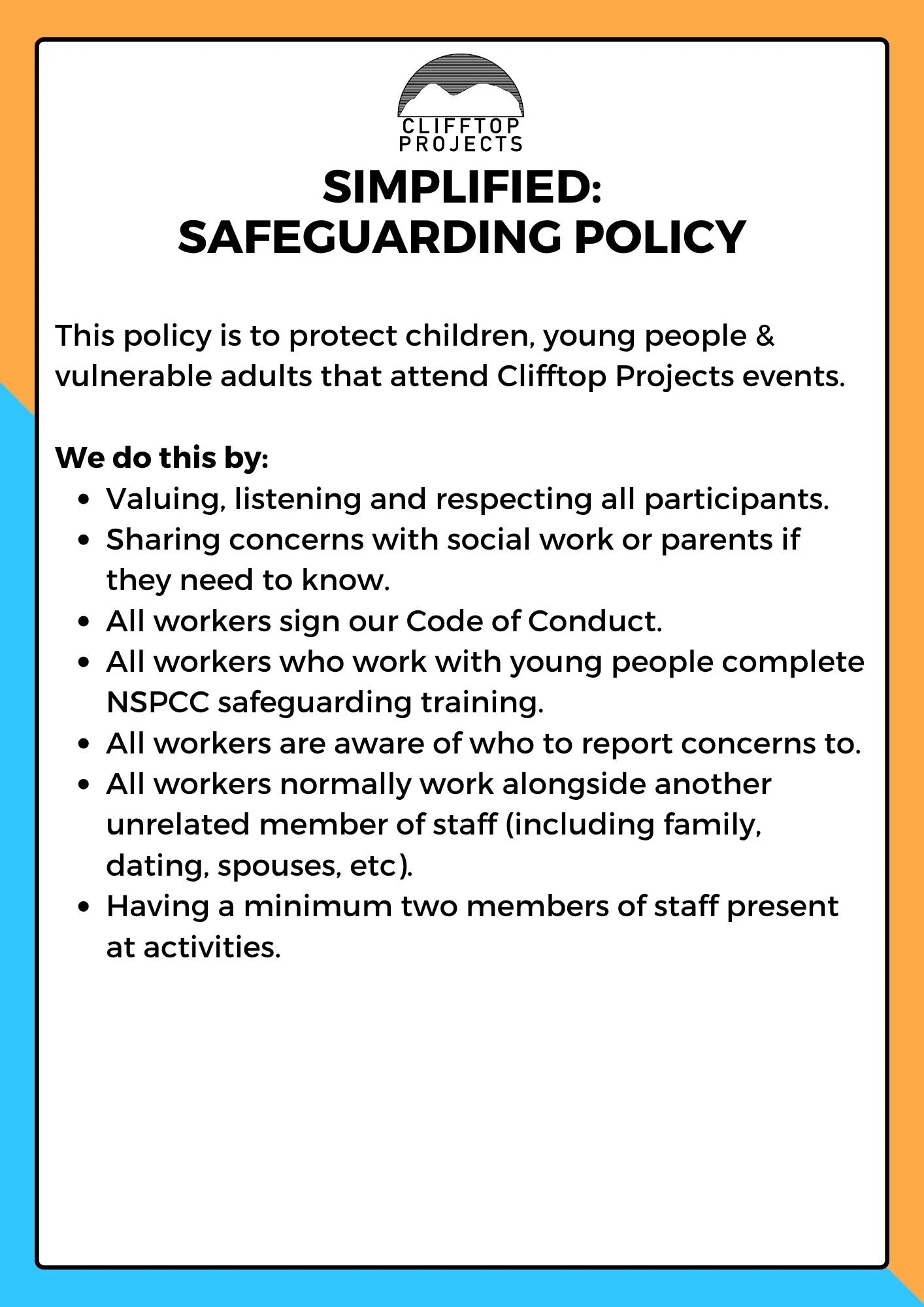
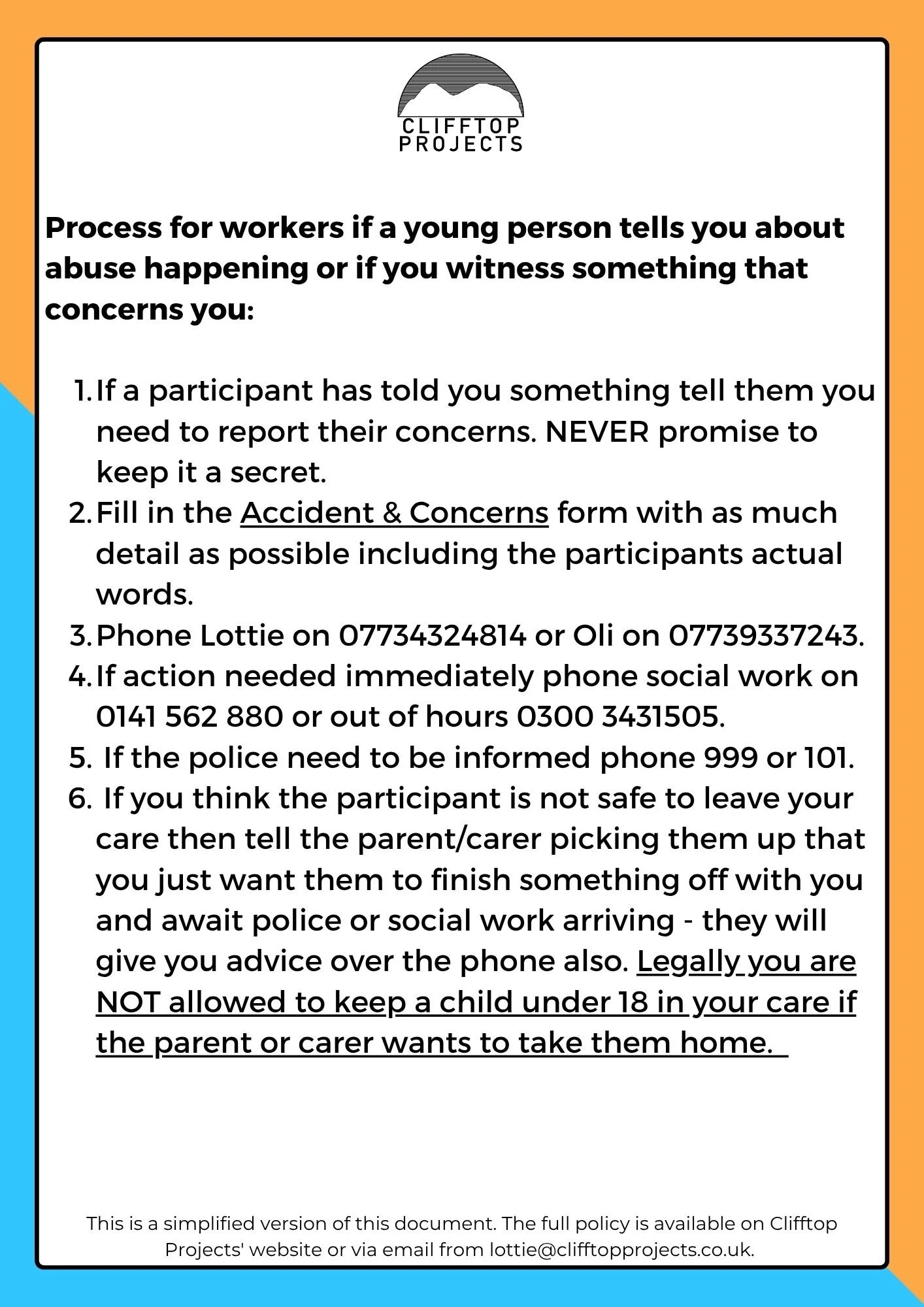
SAFEGUARDING.
ANTI-RACISM.
We encourage staff & freelancers to be aware of how to talk to young people & children about race as well as challenging (when appropriate) any racist sentiments.
Talking to children about racism - this is a great resource from British Red Cross with some practical tips on what to do if you hear a racist comment.
If you are interested in receiving specific training from NSPCC on anti-racism please speak to Lottie or Ash.
PEOPLE ARE FREE TO BE THEMSELVES.
This is one of the core beliefs of Clifftop Projects - it is important to ensure therefore that your language is non-judgemental when speaking both to participants or in earshot of participants. We aim not to put people into a box so try to refrain from saying things like:
“You’re so mature for your age” -although this can seem like a compliment it can make a young person feel extra responsibility & we want them to feel safe to freely be a kid in our space.
“You’re the quiet one/ loud one/ shy one” - anything that labels someone as just one type of person - we encourage participants to be all versions of themselves and not have to fit into one box.
“I’d be really happy if you did this” - we don’t want to encourage young people to do things just to people please us! Try to find another way to ask the young person to get involved.
“It’s just our secret” - you should never promise a participant that something is a secret - even if it seems like something trivial like a broken pen- it can break a young person’s trust too easily if they find out you told someone else.
“You’ve got such pretty eyes” - you shouldn’t compliment things about a person’s physical appearance that they have no control over. For example if they’ve dyed their hair or styled it a certain way that’s a choice and you can compliment eg ‘Oh i love your green mohawk’ but something that is just a part of their body shouldn’t be complimented eg ‘You’ve got gorgeous little ears’.
LGBT CHARTER INFO.
Clifftop Projects is currently undertaking our Bronze Charter with LGBT Youth Scotland. We are an LGBT Friendly organisation and do not tolerate discrimination of any kind from staff or participants. Some resources for you are below:
What is a pronoun & why it matters to use them correctly - We have pronoun badges available for all staff & freelancers - if you haven’t been offered one and would like one please ask Lottie or Ash!
How to respond to homophobic language - We encourage all staff & freelancers to challenge discriminatory statements of any kind when it is safe to do so even when they are said as a ‘joke’. This guide helps you understand how to respond.
You can guide young people to this website if they need more support: https://lgbtyouth.org.uk/get-support/
DISABILITY AWARENESS.
We are a disability friendly organisation and aim to create spaces that are accessible for disabled staff, freelancers & participants. We look at things through the social model of disability:
The model says that people are disabled by barriers in society, not by their impairment or condition. Barriers can be physical, like buildings not having accessible toilets. Or they can be caused by people's attitudes to difference, like assuming disabled people can't do certain things.
The social model helps us recognise barriers that make life harder for disabled people. Removing these barriers creates equality and offers disabled people more independence, choice and control.
We aim to provide bespoke accessibility for everyone engaging with Clifftop Projects - as a freelancer it is your responsibility to ensure that everyone feels welcome and able to take part in our activities.
Disability inclusive language - this page has some great top tips for what language to use and what to avoid.
Remember that not all disabilities are visible and that they may also look different day to day, hour to hour or minute to minute. It is best to ask “what can we do to make this experience a good one for you” in order to get specific information rather than ask for a medical diagnosis which won’t give us much to work with!
If you have not received Autism Awareness training please ask Lottie or Ash.
CARE EXPERIENCE.
We often work with young people who have experience of care. We therefore ask you to think about the following things:
Use the phrase ‘grown ups’ instead of ‘mum’ ‘dad’ or ‘parents’ - this enables young people who live in foster care, kinship care, residential homes or any other non-traditional household to feel included and like they don’t have to explain who they live with.
If a care experienced young person needs more support please direct them to Who Cares Scotland.
Use a trauma informed approach - being aware that behaviours that are challenging may well be as of a result of something bigger and require an understanding, non-judgemental response. You can read more about the six principles of the trauma informed approach here.
A MISCONCEPTION: This does not mean we let bad behaviour happen unchallenged!! Instead it means we ask ourselves WHY is it happening and help the young person understand the natural consequences rather than shouting or punishments that are unrelated to their actions. If a young person has behaved in a way that is unacceptable and has been spoken to about it it should be relayed to their grown ups at the end of the session.
CHALLENGING BEHAVIOUR.
Understanding Challenging Behaviour - Youth Scotland has a great resource on WHY challenging behaviour might happen and this can prepare you for these situations.
If participants get into a physical or verbal altercation with each other you should attempt to separate them if safe to do so and only ever use reasonable force to do so - this means using no more force than is needed (ideally just a hold of a hand to guid them into another space). A conversation should be had with both participants about the incident and ideally a resolution reached with both apologising and agreeing to move on. The incident should ALWAYS be reported to Lottie using the form above immediately (and via Whatsapp or text as well) and detailed to the adult picking up a young person at the end of a session.
Occasionally young people attempt to run outside during a session. In an incident like this an adult should follow the child outside and attempt to guide them back inside the building. You should only touch the child if it is to stop them going into a road or somewhere else unsafe - otherwise you can ask if they’d like to hold your hand to walk back to the building. Find out WHY they wanted to leave and what we can do to rectify the situation. It should ALWAYS be detailed to the adult picking the young person up.